
Staying in History: The Story Behind Museum Residence Oxford and St Aldate’s
- Ardelle

- Jun 8
- 7 min read
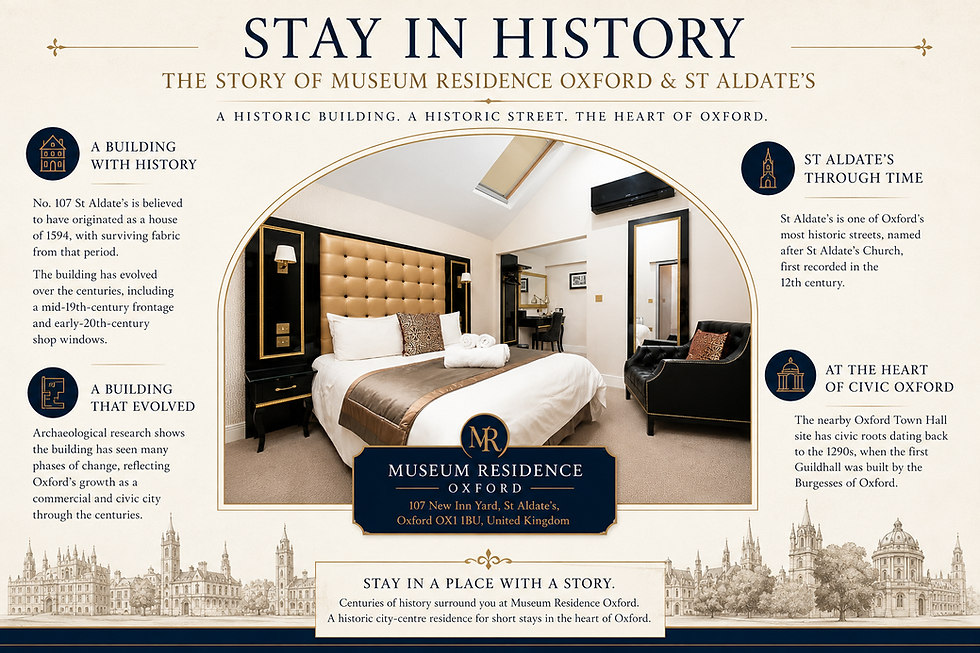
Oxford is a city where history is not hidden away in museums alone. It is built into the streets, the stones, the courtyards, the churches, the college walls, and the buildings that have quietly changed with the city over centuries.
Museum Residence Oxford, located at 107 New Inn Yard, St Aldate’s, Oxford OX1 1BU, United Kingdom, offers guests the opportunity to stay in one of Oxford’s most historic central areas. This is not just a practical base for visiting the city. It is a location connected to the long story of Oxford itself.
From the medieval street layout of St Aldate’s to the historic character of the building at 107 St Aldate’s, staying here means experiencing Oxford from the inside rather than simply visiting it from a distance.
A Building with Deep Historical Roots
The building connected with Museum Residence Oxford has a history that reaches back many centuries. According to Historic England, No. 107 St Aldate’s is believed to have originated as a house of 1594, with surviving fabric from that period still forming part of the building’s story. (Historic England)
Over time, the building was altered, extended, adapted, and reshaped. Historic England notes that while the building has earlier origins, it also includes a mid-19th-century street frontage and early-20th-century shop windows. (Historic England)
This makes the building a strong example of how Oxford’s historic properties have evolved. They were not frozen in one period. Instead, they changed as the needs of the city changed: from homes to businesses, from street-facing shops to modern city-centre accommodation.
From Historic House to City-Centre Residence
An Oxford Archaeology report on 107 St Aldate’s describes the building as one that has gone through many phases of alteration and extension. The report explains that the importance of the building is not only in its architectural appearance, but in the way it records the development of a city-centre property over time. (OA Library)
The building reflects the story of Oxford as a working city, not only a university city. It shows evidence of commercial use, adaptation, and local business activity. It also preserves the idea of a historic burgage plot: the long, narrow medieval property layout that shaped many older towns and city centres. (OA Library)
This is part of what makes staying in a historical location meaningful. Guests are not only close to famous landmarks; they are staying in a building that has its own relationship with Oxford’s development.
The Meaning of St Aldate’s
St Aldate’s is one of Oxford’s most central and historic streets. It runs through the heart of the city, connecting the area around Carfax with Oxford Town Hall, the Museum of Oxford, Christ Church, Pembroke College, and the route towards the River Thames.
The street is closely connected with St Aldate’s Church, one of the historic parish churches of Oxford. Oxfordshire Heritage Search notes that the parish church of St Aldate’s was first recorded in the 12th century. (Heritage Search)
This means the area has been part of Oxford’s civic, religious, and urban life for hundreds of years. Today, St Aldate’s remains one of the city’s most important central streets, linking guests directly to both historic landmarks and everyday Oxford life.
A Street at the Centre of Civic Oxford
St Aldate’s has always had a strong civic character. The Museum of Oxford is located inside Oxford Town Hall, and the history of that site goes back to the medieval period.
The Museum of Oxford explains that the first civic building on the current Town Hall site was a Guildhall built in the 1290s by the Burgesses of Oxford. Later, in the 18th century, the city developed a new town hall, and today the site continues to represent Oxford’s civic identity. (Museum of Oxford)
Oxford Town Hall also records that the current building is the third purpose-built town hall on the site, with the first Guildhall constructed in the 1290s on St Aldate’s. (Oxford City Council, Town Hall)
For guests staying at Museum Residence Oxford, this matters because the residence is located within the same historic civic environment. You are not outside the city looking in. You are staying beside the places where Oxford’s public life, local government, community history, and urban identity have developed for centuries.
New Inn Yard and the Historic Character of Oxford’s Back Streets
Museum Residence Oxford is located at New Inn Yard, just off St Aldate’s. Yards and lanes like this are part of the character of old Oxford. They remind us that the city was not only shaped by grand college buildings and famous towers, but also by smaller working spaces behind the main street frontages.
New Inn Yard gives the residence a quieter and more private setting while still keeping guests moments away from the energy of the city centre. This contrast is part of Oxford’s charm: main streets full of history and movement, with smaller yards and passages offering a more intimate side of the city.
For guests, this means they can step out into one of Oxford’s most historic central streets, while returning to a residence that feels more discreet and tucked away.
Oxford’s Layers: Medieval, Victorian and Modern
One of the most interesting things about Museum Residence Oxford is that the building reflects different periods at once.
Its origins are connected to the late 16th century, while its street frontage was reshaped in the 19th century, and its later use has adapted to the needs of modern guests. Historic England’s listing shows this layering clearly: early origins, later frontage, and shop windows from a different period again. (Historic England)
This is typical of Oxford, where buildings often combine medieval layouts, Georgian or Victorian changes, and contemporary interiors. The result is not a museum-like experience, but a living historical one. Guests can enjoy modern comfort while still feeling connected to the older character of the city.
This is also what makes Oxford special. The past has not disappeared. It continues to shape how people move, stay, work, study, and experience the city today.
Staying Near Oxford’s Historic Landmarks
Staying at Museum Residence Oxford places guests close to some of the city’s most important historic sites.
Carfax Tower is only a short walk away and marks one of Oxford’s central points. Christ Church, one of the city’s most famous colleges, is nearby on St Aldate’s. The Museum of Oxford, Oxford Town Hall, the Covered Market, the High Street, the Bodleian Library, and the Radcliffe Camera are all within easy walking distance.
This means guests can explore Oxford naturally, without needing to plan complicated transport. The historic city is immediately accessible from the residence.
For visitors interested in history, this is one of the strongest reasons to stay centrally. Oxford is best understood by walking through it.
More Than a Place to Stay
A stay at Museum Residence Oxford is more than a practical overnight choice. It offers a real sense of place.
Guests are staying in a location connected to Oxford’s civic history, historic street pattern, university atmosphere, and everyday city life. The building itself reflects centuries of change, while the surrounding streets connect guests to some of Oxford’s most famous landmarks.
This creates a different type of travel experience. Instead of staying in a generic location outside the centre, guests can enjoy a private, characterful city-centre residence in the heart of historic Oxford.
The Experience of Staying in a Historic Location
There is something special about waking up in the heart of Oxford. The city is quieter in the morning, before the streets fill with visitors. From Museum Residence Oxford, guests can step outside and immediately find themselves surrounded by historic architecture, college walls, museums, cafés, shops, and old city routes.
In the evening, the experience changes again. The streets become calmer, the lights reflect on the old buildings, and Oxford feels more intimate. Staying centrally allows guests to enjoy these moments, not just the busy daytime version of the city.
This is why historical location matters. It gives guests time to experience the atmosphere of Oxford, not only its attractions.
Why Choose Museum Residence Oxford?
Museum Residence Oxford is ideal for guests who want comfort, independence, and a central location with historical character.
The residence offers a practical base for sightseeing, university visits, graduation stays, cultural trips, romantic weekends, business travel, and short city breaks. Its location at 107 New Inn Yard, St Aldate’s, places guests close to Oxford’s most important landmarks while offering the feeling of staying somewhere with a story.
For travellers who value atmosphere as much as convenience, this is one of the best reasons to choose a historic city-centre residence.
Final Thoughts
Oxford is a city of layers. Its history is found in its colleges and museums, but also in its streets, yards, buildings, and everyday spaces.
Museum Residence Oxford sits within this historic landscape. The building connected to 107 St Aldate’s has roots going back to the late 16th century, while St Aldate’s itself is one of the city’s most historic central streets.
Staying here means more than being close to Oxford’s attractions. It means becoming part of the city’s story, even if only for a few nights.
For guests who want to experience Oxford from a truly central and historically rich location, Museum Residence Oxford offers a memorable place to stay.
Sources
Historic England – No. 107 St Aldate’s, Oxford
Historic England lists No. 107 St Aldate’s as a Grade II listed building believed to have originated as a house of 1594, with surviving historic fabric, later alterations, a mid-19th-century frontage, and early-20th-century shop windows.
https://historicengland.org.uk/listing/the-list/list-entry/1445689
Oxford Archaeology – 107 St Aldate’s Oxford Report
Oxford Archaeology’s building report explains the historical development of 107 St Aldate’s, including its significance, alterations, and relationship to a medieval burgage plot.
https://eprints.oxfordarchaeology.com/6173/
https://eprints.oxfordarchaeology.com/6173/1/OX107A14_Report.pdf
Museum of Oxford – The History of Our Museum
The Museum of Oxford explains that the first civic building on the current Town Hall site was a Guildhall built in the 1290s by the Burgesses of Oxford.
Oxford Town Hall – History
Oxford Town Hall describes the site’s civic history, including the first Guildhall built on St Aldate’s in the 1290s and the later development of the Town Hall.
Oxfordshire Heritage Search – St Aldate Parish Records
Oxfordshire Heritage Search notes that the parish church of St Aldate’s was first recorded in the 12th century.
The Museum Residence
107a St. Aldates, Oxford, OX11BU
Tel: +44 (0) 1865 819654
and +44 (0) 1865 819655
Please don’t hesitate to contact us at +44 7393 107107
between 10:00 - 20:00


Comments